How to use the TV size calculator
- Sit where you usually watch and measure from your eyes to the wall or stand where the screen will be.
- Measure your seated eye height from the floor.
- Choose how immersive you’d like it: relaxed, mixed or cinema.
- Enter a screen size to check a TV you already have, or leave it blank to use the suggested size.
How the size is worked out
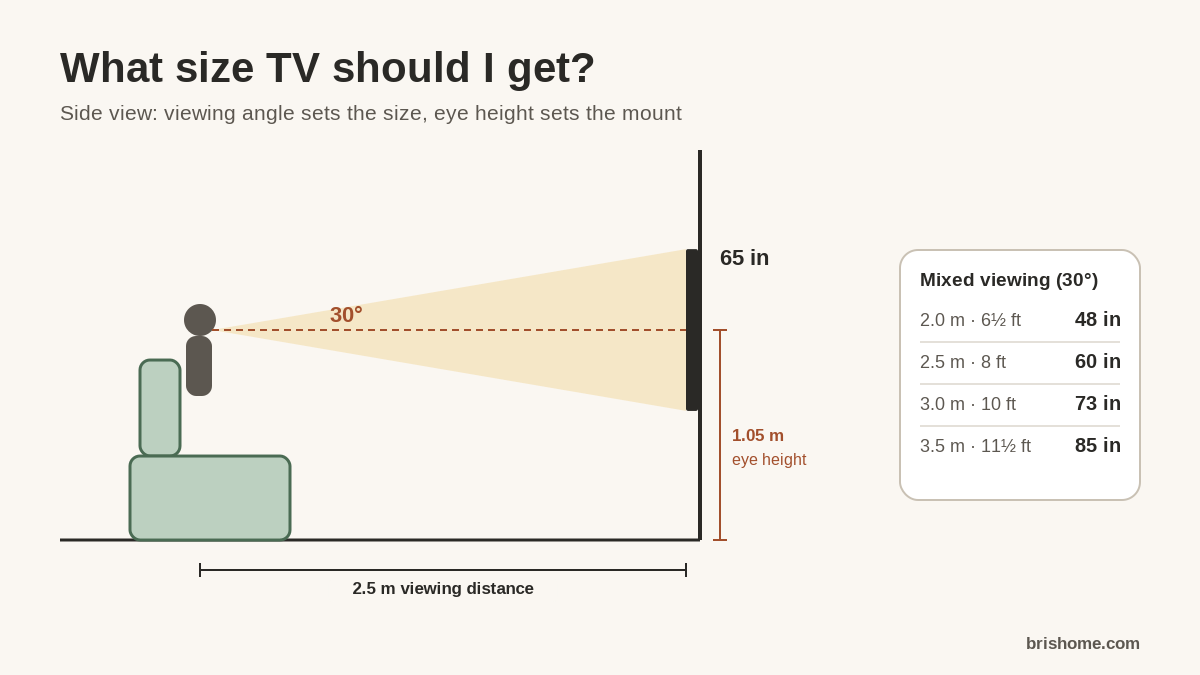
- Screen width = 2 × viewing distance × tan(viewing angle ÷ 2). The angles are about 20° for relaxed viewing, 30° for mixed (close to the SMPTE recommendation) and 40° for cinema (close to the THX recommendation).
- Diagonal = width × 1.147 for a 16:9 screen, converted to inches.
- Resolution: with normal vision the eye resolves about one arcminute (1/60°). A screen shows all its detail once it is at least pixels across × distance × tan(1′) wide.
- Height: the centre of the screen goes at your seated eye height. If a fireplace or unit is in the way, the screen moves up and the calculator shows the upward viewing angle.
Worked example
A sofa 2.5 m from the wall, mixed viewing, eyes 1.05 m from the floor.
- Width: 2 × 2.5 m × tan 15° = 1.34 m. Diagonal: 1.34 × 1.147 = 1.54 m, or about 60.5 inches. The nearest common sizes are 55 and 65 inches.
- A 65-inch screen is about 144 × 81 cm. With its centre at 105 cm, the bottom edge sits about 65 cm from the floor.
Choose Try an example above (with metric selected) to load these numbers.
Assumptions and limitations
- Screens are assumed to be 16:9, which almost all TVs are. Sizes are the visible screen diagonal; frames and stands add a little.
- Viewing angles are guidelines from film and broadcast standards bodies, not rules. Choose what feels comfortable.
- The resolution check assumes normal (20/20) vision and good source material.
- Wall mounting must suit the wall and the TV’s weight. Follow the mount maker’s instructions, and use a professional if you’re unsure what the wall is made of.
Frequently asked questions
What size TV should I get for my room?
Measure from where your eyes will be when seated to where the screen will hang. For general viewing, a screen that fills about 30° of your view is a good size: the screen’s diagonal is roughly 0.6 × the viewing distance. At 2.5 m (about 98 inches), that’s a screen of about 60 inches.
How high should a TV be mounted?
For comfortable viewing, put the centre of the screen at about your seated eye height, which is often around 100–110 cm (39–43 in) from the floor for a typical sofa. Measure yourself sitting down: seat heights and people vary. Looking up more than about 15° for long periods can strain your neck.
Is it OK to mount a TV above a fireplace?
It often puts the screen too high for comfortable viewing, and heat and soot from a working fire can affect electronics. If you do, sit further back, consider a mount that tilts down or pulls down, and check the TV maker’s guidance on heat. The calculator shows how far you’ll be looking up.
Is 4K worth it at my viewing distance?
It depends on screen size and distance. With normal vision you can see individual pixels when each one spans more than about one arcminute of your view. The calculator works out the screen size at which a resolution’s full detail becomes visible from your seat. 4K also brings other improvements, such as HDR and better processing, so it is still the usual choice.
Are TV sizes measured with the frame?
No. The size is the diagonal of the visible screen in inches. The overall width with the frame and stand is a little larger; check the product’s specification sheet before you buy a TV unit or plan a recess.
Last updated .