Good lighting makes a room look bigger, cleaner and more welcoming. Poor lighting makes even a freshly decorated room feel flat. You don’t need to be a lighting designer to get it right; you need three numbers from the bulb box and a simple plan.
Three numbers on the box
- Lumens (lm) measure how much light a bulb gives out. This is the number to compare. A modern LED sold as a “60 W equivalent” typically gives around 800 lm.
- Watts (W) measure the power it uses. For LEDs, watts tell you about running cost, not brightness.
- Kelvin (K) describes the colour of the light. Lower numbers are warmer and more yellow; higher numbers are cooler and whiter.
| Old bulb | Roughly equivalent LED output |
|---|---|
| 40 W | about 470 lm |
| 60 W | about 800 lm |
| 75 W | about 1,100 lm |
| 100 W | about 1,600 lm |
How much light does a room need?
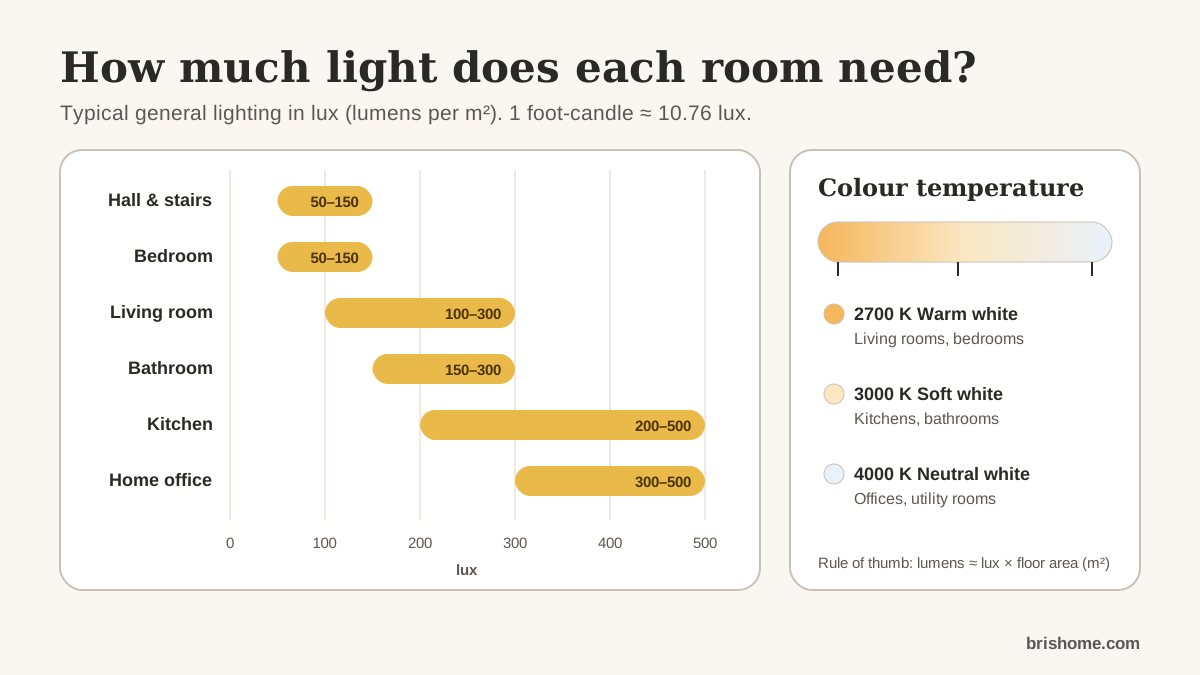
Light landing on a surface is measured in lux (lumens per square metre). In the US you may see foot-candles (lumens per square foot); one foot-candle is about 10.76 lux.
Typical general light levels in homes:
| Room | Typical general lighting |
|---|---|
| Living room | 100–300 lux |
| Kitchen | 200–500 lux (more on worktops) |
| Bedroom | 50–150 lux |
| Bathroom | 150–300 lux |
| Home office | 300–500 lux |
| Hall and stairs | 50–150 lux |
Guides quote different ranges, and older eyes usually need more light, so treat these as starting points.
The rule of thumb
Lumens needed ≈ target lux × floor area in m²
A living room 4 × 3.5 m is 14 m². At 150 lux it needs about 150 × 14 = 2,100 lumens, so three 800 lm bulbs.
Dark walls and floors absorb light, and tall ceilings put the lights further from where you need them, so add some extra in those rooms. Our lighting calculator adds allowances for both and works out the number of bulbs for the lumens you choose.
Spacing downlights
For an even wash of light, a common rule is to space downlights about as far apart as the ceiling height, and about half that distance from the walls. In a room with a 2.4 m (8 ft) ceiling, that means lights roughly 2.4 m apart and 1.2 m from the walls. Narrow-beam fittings need to be closer together, so check the beam angle on the fitting.
The lighting calculator draws an even grid for your room and gives the measurements to mark on the ceiling.
Choosing colour temperature
- 2700 K (warm white): cosy and relaxing. Good for living rooms and bedrooms.
- 3000 K: still warm, a little crisper. A common choice for kitchens and bathrooms in homes.
- 4000 K (neutral white): clear and bright. Good for home offices, utility rooms and task lighting.
Keep the colour temperature the same within a room, or the lights will look mismatched. Also look for a high colour rendering index (CRI), often 90 or above, where colours matter, such as in a kitchen or at a mirror.
Light also changes how paint looks. Warm light makes colours warmer and cool light makes them cooler, so test paint samples under the bulbs you’ll use. Our colour scheme planner shows how light each colour is likely to look.
Layer the light
Rooms work best with three layers:
- General (ambient) light from the ceiling, for moving around and cleaning.
- Task light where you read, cook, work or put on make-up, aimed at the work.
- Accent and mood light from lamps, wall lights or LED strips, for the evening.
Put the general lighting on a dimmer (with dimmable bulbs), and a single room can be bright for cleaning and soft for relaxing.
Safety
Fixed wiring must follow local regulations, and in many places it must be done or certified by a qualified electrician. In bathrooms, use fittings rated for the zone they sit in.
This guide is general information, not professional advice. Measurements, product instructions and local regulations come first.