Running out of paint with one wall to go is annoying. Buying three tins too many is expensive. The good news is that the sum is simple once you know which numbers to use, and the most important one is already printed on your tin.
The short version
- Measure the wall area: the distance around the room × the wall height.
- Take off doors and windows you won’t paint.
- Multiply by the number of coats (usually two).
- Divide by the coverage on the tin, in m² per litre or sq ft per gallon.
- Round up to whole tins, and keep a little back for touch-ups.
Our paint calculator does each of these steps for you and shows the working, so you can check it.
Step 1: measure the walls
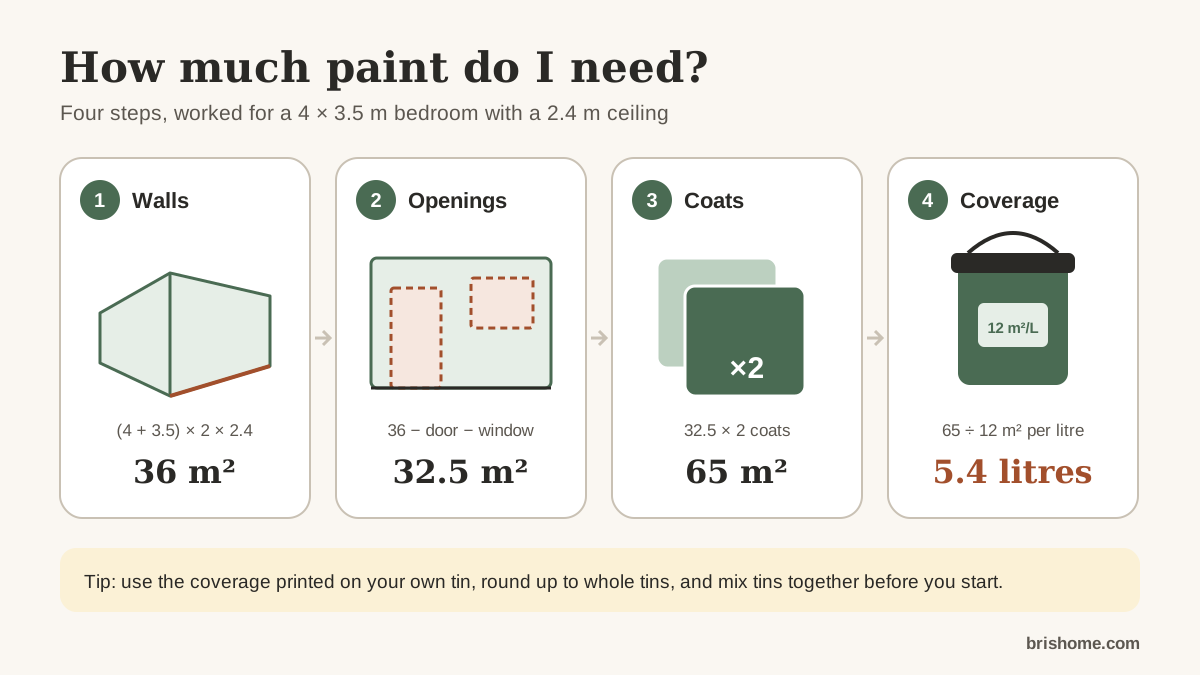
Measure the length of each wall at skirting (baseboard) height, and add them together to get the perimeter. Then measure the height from the floor to the ceiling. In a rectangular room:
Wall area = (length + width) × 2 × height
For example, a bedroom 4 m × 3.5 m with a 2.4 m ceiling has a perimeter of 15 m and a wall area of 15 × 2.4 = 36 m². In feet, a 13 ft × 11 ft 6 in room with an 8 ft ceiling has 49 ft of wall and 49 × 8 = 392 sq ft.
If the room isn’t a simple rectangle, measure each wall on its own and add them up. A room area calculator helps with L-shaped floors and ceilings.
Step 2: take off doors and windows
Subtract the areas you won’t paint. Measure each one, or use these rough sizes as a starting point:
| Opening | Rough size |
|---|---|
| Internal door | about 1.6–2 m² (17–21 sq ft) |
| Standard window | about 1.2–2 m² (13–21 sq ft) |
| Patio or French doors | about 3–4 m² (32–43 sq ft) |
Small openings make little difference, and many painters leave them in as a margin. Large windows and doors are worth taking off.
Step 3: count the coats
Most walls need two coats for an even finish. Plan for more when:
- you are covering a dark colour with a light one, or the other way round. A primer or an extra coat is common.
- the wall is new plaster or bare board, which soaks up paint. Plaster usually needs a thinned “mist coat” first; follow the paint maker’s advice.
- you are using a strong, bright colour such as red or yellow, which often needs an extra coat to look solid.
One coat is sometimes enough when you are refreshing the same colour on a sound wall.
Step 4: use the coverage on the tin
Coverage is how much wall a litre or gallon covers in one coat. It varies a lot between products. Many interior wall paints list somewhere around 10–16 m² per litre, or roughly 350–400 sq ft per US gallon, but always use the figure printed on the tin you are buying. Rough, textured or porous walls take more paint than the label suggests.
Continuing the bedroom example with two coats and a door and window taken off:
- Paintable area: 36 m² − 3.5 m² = 32.5 m²
- Two coats: 32.5 × 2 = 65 m²
- At 12 m² per litre: 65 ÷ 12 = 5.4 litres
That means a 5 litre tin is not quite enough. You might buy a 5 litre and a 1 litre tin, or two 2.5 litre tins and a 1 litre.
Ceilings and woodwork
Ceilings are measured as floor area: length × width. They are usually painted in a flat white, and two coats is again typical.
Woodwork (skirting, door frames and doors) takes far less paint. A litre of gloss or satin goes a long way, and a 750 ml tin is often enough for the trim in one room. If you are painting doors as well, measure each face.
Tips so you don’t run out
- Buy it all at once. Colours mixed on different days can differ slightly. If you need several tins, mix them together in a larger bucket before you start (“boxing” the paint) so every wall matches.
- Keep a little back. A small jar labelled with the room, colour and date makes touch-ups easy.
- Test first. Paint a large sample on two walls and look at it in the morning and evening before you buy the full amount. Our colour scheme planner helps you choose the colours that go with it.
Common questions
Is it cheaper to buy a bigger tin? Often, per litre, but not if half of it dries out in the shed. Buy what you need plus a small margin.
Do I need primer? For bare wood, metal, stains, or a big colour change, usually yes. For a wall already painted in a similar colour, usually not. Check the paint’s instructions.
How accurate is the estimate? It is a good guide for smooth, previously painted walls. Use the tin’s figure, measure carefully, and round up.
This guide is general information, not professional advice. Measurements, product instructions and local regulations come first.