Wallpaper is one of the easiest things to buy too little of. A paint shortfall can be fixed with another tin; a wallpaper shortfall means hunting for a roll from the same batch, which may no longer be in stock. The answer is to work in strips, not square metres, and to allow for the pattern.
This guide explains the strip method step by step. The wallpaper calculator does it for every wall in your room and shows a cutting plan for each roll.
Why square metres doesn’t work
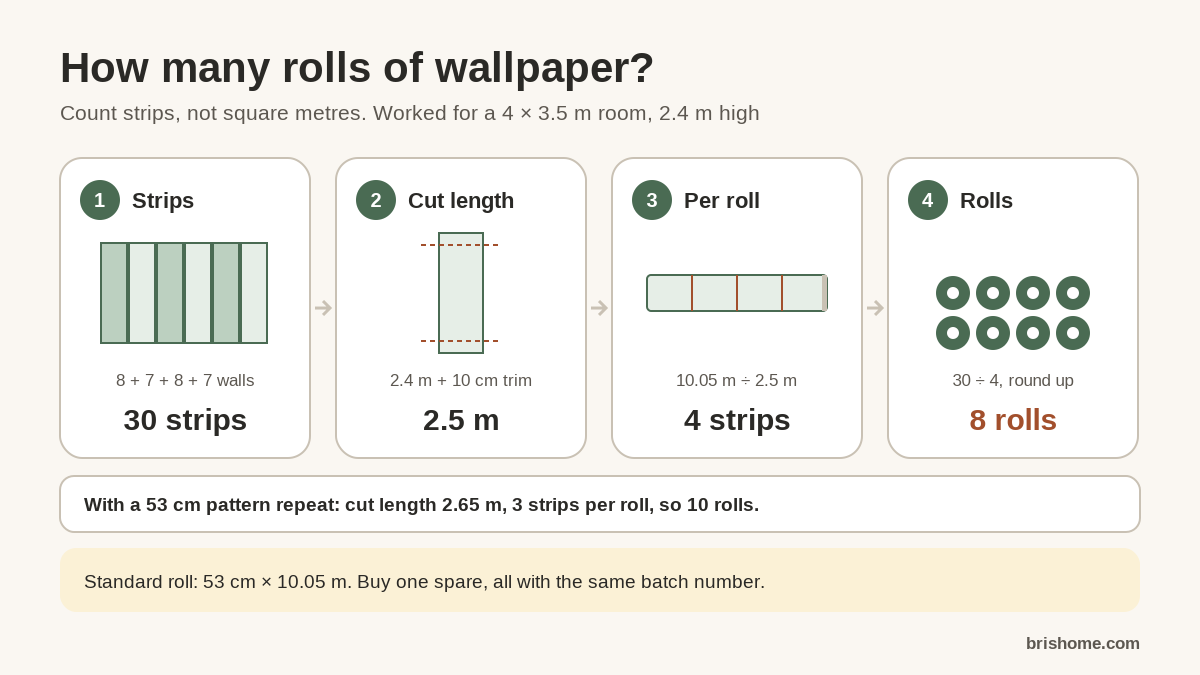
Dividing the wall area by the area of a roll gives a number that is always too low. Every strip has to be cut at full height, plus trimming, and rounded up to the pattern. The leftover at the end of each roll is usually too short for another full strip. Counting strips captures all of that.
Step 1: measure the walls
Measure the width of each wall and the height from the top of the skirting (baseboard) to the ceiling. Measure the height in a couple of places in older homes. Write each wall down separately.
Step 2: count strips per wall
Strips = wall width ÷ roll width, rounded up
With standard 53 cm rolls:
- A 4 m wall: 4 ÷ 0.53 = 7.5, so 8 strips.
- A 3.5 m wall: 3.5 ÷ 0.53 = 6.6, so 7 strips.
A 4 × 3.5 m room therefore needs 8 + 7 + 8 + 7 = 30 strips.
Step 3: work out the cut length
Cut length = wall height + trim allowance, rounded up to whole pattern repeats
Allow about 5 cm at the top and 5 cm at the bottom for trimming, so 10 cm in total.
- Plain paper or a random match: 2.4 m + 0.1 m = 2.5 m.
- Patterned paper with a 53 cm repeat: 2.5 ÷ 0.53 = 4.7 repeats, so round up to 5 repeats = 2.65 m.
The bigger the repeat, the more paper each strip uses. A 64 cm repeat on the same wall would need 4 repeats (2.56 m); a 70 cm repeat would need 4 (2.8 m).
Straight match and drop match
- Straight match: the pattern lines up straight across from strip to strip.
- Drop (or offset) match: each strip starts half a repeat lower than the last. It usually wastes a little more paper, because you cut alternate strips from different points on the roll.
Step 4: strips per roll
Strips per roll = roll length ÷ cut length, rounded down
With a 10.05 m roll:
- Plain: 10.05 ÷ 2.5 = 4.02, so 4 strips per roll.
- Patterned: 10.05 ÷ 2.65 = 3.8, so 3 strips per roll.
Round down, because a part strip is no use for a full-height drop.
Step 5: rolls to buy
Rolls = strips ÷ strips per roll, rounded up
- Plain: 30 ÷ 4 = 7.5, so 8 rolls.
- Patterned: 30 ÷ 3 = 10 rolls.
That 53 cm pattern repeat costs two extra rolls in this room. Add one spare roll for mistakes and future repairs.
Imperial example
US wallpaper is often sold in double rolls about 20.5 in wide and 33 ft (396 in) long.
- A 12 ft (144 in) wall: 144 ÷ 20.5 = 7.02, so 8 strips.
- An 8 ft ceiling plus 4 in trim: cut length 100 in.
- Strips per double roll: 396 ÷ 100 = 3.96, so 3 strips.
- Four 12 ft walls: 32 strips ÷ 3 = 11 double rolls.
That last strip on each wall is barely wider than the wall needs, which is why it pays to measure accurately.
Doors, windows and chimney breasts
- Doors and windows: leave them in for standard openings. Strips either side are still full height, and the offcuts cover above and below. For patio doors or wide windows, you can save a strip or two.
- Chimney breasts: measure the front and both returns as separate narrow walls.
- Sloping ceilings: measure the tallest point of each strip position. The calculator lets you enter separate wall heights.
Feature walls
One wallpapered wall behind a bed or sofa is a popular way to use a bold pattern without committing a whole room. Work it out the same way. Paint the other walls in a colour drawn from the paper: the 60-30-10 colour rule helps you choose, and the paint calculator works out how much paint to buy.
Before you buy
- Check the batch (or lot) number. Rolls from different batches can differ slightly in colour. Buy them all at once with the same number.
- Check the label symbols for the repeat, match type and whether it is paste-the-wall or paste-the-paper.
- Unroll and check each roll in good light before you start cutting.
- Keep the labels until the job is finished.
Common mistakes
- Using square metres instead of strips.
- Ignoring the pattern repeat, which can add 20–30% to the rolls you need.
- Rounding strips per roll up instead of down.
- Buying the exact number. Always buy one spare.
- Mixing batches.
Lining paper
Lining paper hides small cracks and gives a smooth base. It is usually hung horizontally, so work it out by area or use the same strip method across the wall width. Check the paper maker’s advice on whether lining is needed.
Frequently asked questions
How many rolls of wallpaper do I need for a 4 × 4 m room?
How many rolls of wallpaper for one feature wall?
Do I subtract doors and windows for wallpaper?
What is a pattern repeat?
What size is a roll of wallpaper?
This guide is general information, not professional advice. Measurements, product instructions and local regulations come first.